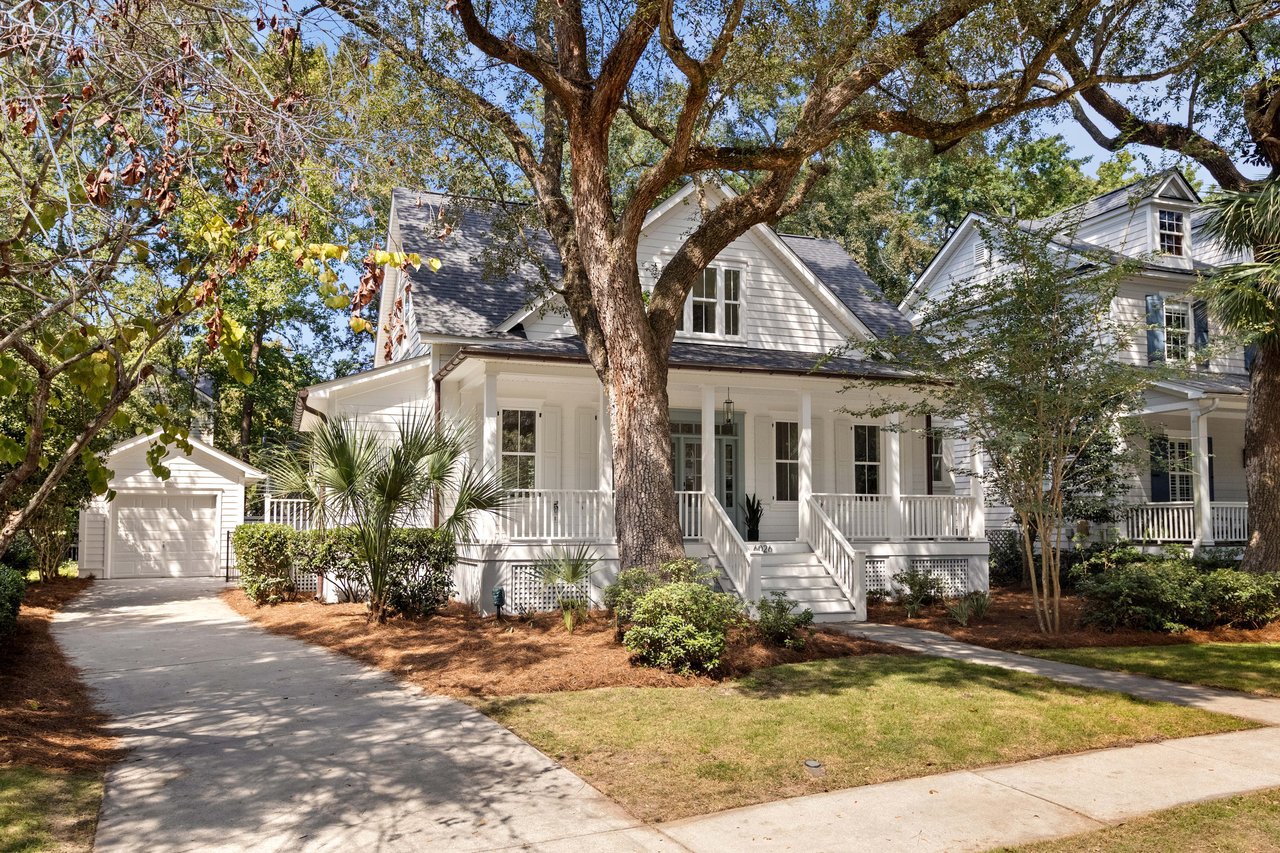
A homeowner south of Broad decides to add a screened porch off the back of her Charleston single. She figures on a contractor, six weeks, maybe a long weekend of noise for the neighbors. Eight months later she is waiting on a second appearance before a design review board that has been signing off on exterior changes to peninsula houses since 1931. The porch gets built eventually. The timeline never recovers.
That story shows up in renovation circles downtown often enough that it barely counts as a warning anymore. It counts as the baseline. And it points to the actual number that matters more than anything a portal search will show you before you make an offer on a downtown Charleston home: not the median sale price, but the flood zone letter and design-review jurisdiction attached to that specific block.
How downtown median prices compare
Here is a comparison that needs context. In March 2026, the median sale price in South of Broad reached $3,495,000, up 60.7 percent year over year. That same geography sits inside ZIP code 29401, which also covers the French Quarter and Harleston Village. A June 2026 market report for that same ZIP put the median sale price at $895,000.
Those two numbers cover different geographic boundaries and reporting months, so they are not directly comparable. But "downtown Charleston" is not one market. It is a collection of blocks, each carrying its own combination of flood exposure, historic review requirements, and renovation ceiling, and those factors move price and cost independently of whatever the aggregate median says.
If you are comparing neighborhoods based on the number you saw last week on a listing site, you are comparing a summary of very different realities. The block matters more than the ZIP code, and two specific letters, printed on a FEMA flood map, can tell you about costs that square footage and curb appeal won't show.
Three letters that change what you actually pay
Downtown Charleston's flood risk breaks into a small number of FEMA zone designations, and they are not evenly distributed. Zone AE, a medium-to-high risk designation with an established Base Flood Elevation, covers much of the peninsula, including a large share of South of Broad, the French Quarter, and the lower-lying stretches of Harleston Village. Zone X, carrying moderate to minimal risk, runs along King Street and touches parts of South of Broad, Harleston Village, Radcliffeborough, and upper Ansonborough. Zone VE, a velocity zone tied to wave action, is less common but shows up near the Battery and other waterfront-adjacent parcels.
Zone | Typical downtown location | Reported annual flood premium range |
|---|---|---|
AE | South of Broad, French Quarter, low areas of Harleston Village | roughly $1,500 to $5,000 |
X | King Street corridor, parts of South of Broad, Harleston Village, Radcliffeborough, upper Ansonborough | roughly $400 to $1,200 |
VE | Battery and waterfront-adjacent parcels | typically the highest of the three, priced per property |
Those ranges come from local flood insurance guides published this year, and they are wide on purpose. Since 2021, FEMA has priced flood coverage under a system called Risk Rating 2.0, which sets premiums based on a specific property's elevation, distance to water, construction type, and rebuild cost rather than a flat zone average. Two houses on the same block, in the same zone, can carry meaningfully different premiums depending on how high the lowest floor sits relative to Base Flood Elevation. A neighbor's quote from two years ago tells you almost nothing about what you will pay.
The City of Charleston's own flood FAQ makes a related point worth sitting with: standard homeowners insurance never covers flood damage here, regardless of zone, and about a quarter of the city's flood claims come from areas rated as lower risk. A Zone X designation lowers your odds. It does not make flood insurance optional in any practical sense, and it does not tell you what you will be quoted until you get an actual number on the actual house.
How flood rules affect renovation costs
The flood zone also decides what you are allowed to build without triggering a much bigger project. Block Renovation explains that under the city's floodplain ordinance, if renovation or addition work reaches 50 percent or more of a structure's value within a single year, the entire building has to be brought up to current flood code, not just the new square footage. That is the rule the porch story above ran into. It is also a rule that can add significantly to the cost of many downtown renovation projects.
The City of Charleston says new construction in the Special Flood Hazard Area has to sit two feet above Base Flood Elevation, and a substantial improvement to an existing home has to clear it by one foot, a standard that took effect in July 2020. Getting there means piers, fill, or flood vents, and a raised foundation alone can add $15,000 to $70,000 depending on how much lift is required.
Layer coastal construction standards on top of that. Additions across the Lowcountry run $150 to $300 per square foot this year, and coastal work runs 15 to 30 percent above the same build inland once you account for hurricane-rated materials and flood-compliant foundations. A basic 200-square-foot screened porch that might run $25,000 to $35,000 elsewhere climbs toward $50,000 to $60,000 with better finishes and a gable roof, and pushing that structure onto pilings to satisfy flood rules adds another $5,000 to $15,000. None of that shows up in the asking price. All of it shows up in the first renovation estimate.
A board older than most of the houses it reviews
The other jurisdiction that shapes cost and timeline on the peninsula is Charleston's Board of Architectural Review, created in 1931 as the country's first historic preservation ordinance. Residential projects go to the small board, BAR-S. Larger or commercial work goes to BAR-L.
That review process runs on its own clock, separate from the flood ordinance, and the two can compound. A homeowner clearing the 50 percent threshold on a substantial improvement is often navigating BAR approval for the exterior changes at the same time she is pricing pilings and flood vents for the foundation. Between the two, an addition can spend more time on paper than it does under construction.
None of this means downtown Charleston is a bad place to buy. It means the real cost of ownership on a given block depends on facts that live in a flood map and a permit file, not on the number a portal displays next to a listing photo.
What to actually check before you write an offer
- Look up the property's specific flood zone on FEMA's Flood Map Service Center. It takes a couple of minutes and changes every conversation that follows.
- Ask whether an elevation certificate already exists for the house. The City of Charleston keeps records for properties within its jurisdiction, and a new certificate from a licensed surveyor typically costs $300 to $600 and takes five to ten business days.
- Get an actual flood insurance quote tied to that address before you are under contract, not after. Risk Rating 2.0 means a neighbor's premium is not your premium.
- Ask about the property's flood-zone status when reviewing the elevation certificate.
- If you are planning any exterior renovation, confirm whether the address falls under BAR-S or BAR-L jurisdiction before you budget a timeline.
A few honest answers
Does a Zone X property still need flood insurance? The city's own data shows a real share of claims come from lower-risk zones. Most local guidance treats it as worth pricing out rather than skipping.
Can a house move out of a flood zone over time? Sometimes. If a current elevation certificate shows the property sitting above Base Flood Elevation, an owner can apply to FEMA for a Letter of Map Amendment. It is not automatic, and it depends entirely on the specific elevation data for that address.
If you are weighing a downtown Charleston purchase against a home a few blocks over, the flood zone letter and the review board jurisdiction are worth more than another hour scrolling median prices. Tricia Peterson and the Island House Real Estate team walk buyers through exactly this kind of block-by-block detail before an offer goes in, including coordination with surveyors and contractors when a renovation is part of the plan. Find Your Island. Schedule a private consultation to talk through what a specific downtown address will actually cost you to own.
This article is general information, not legal, tax or financial advice. Consult a qualified professional about your situation.